

IATA updates for the air transport of lithium batteries
New IATA regulations for the air transport of lithium batteries require adjustments to documentation, packaging, and compliance procedures.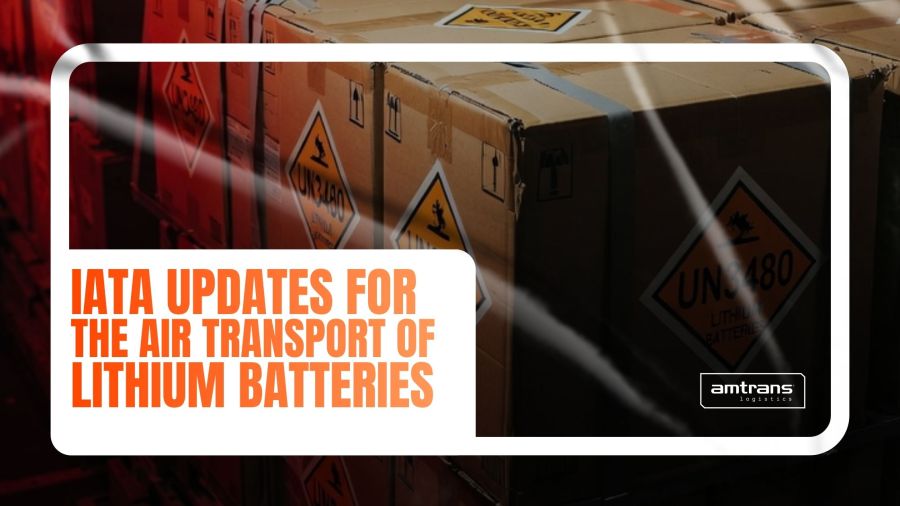
Contents
- Introduction
- Key updates for the air transport of lithium batteries
- Classification and UN codes
- Technical limits and state of charge
- Mandatory testing and technical compliance
- Packaging, protection, and labeling
- Cargo acceptance and supply chain responsibilities
- FAQ - Air transport of lithium batteries
The transport of lithium batteries requires special precautions, as this type of product can cause serious accidents when it does not comply with the required shipping criteria.
A large portion of these shipments is transported by air, mainly due to operational agility and greater control over transport conditions throughout the journey. For companies that rely on logistics predictability, this makes all the difference.
According to International Air Transport Association, these products are classified as Class 9, a category designated for miscellaneous dangerous substances and articles.
Lithium is a highly reactive alkali metal. If a battery fails, becomes damaged, or is handled improperly, several situations may occur:
- short circuit resulting in a fire that is difficult to extinguish,
- thermal runaway with risk of explosion,
- release of toxic gases.
Given this scenario, understanding the updated requirements has become essential for importing and transporting lithium batteries safely.
Key updates for the air transport of lithium batteriesv
The International Air Transport Association shared the 2026 edition of the Battery Guidance Document, introducing new guidelines for the air transport of batteries:
- lithium metal,
- lithium-ion,
- sodium-ion.
In practice, the document reinforces global safety standards and requires even greater attention from the companies involved in the operation. Those who prepare in advance reduce risks and avoid delays.
The main updates are:
UN classification codes
Incorrect classification of the UN code may result in the immediate rejection of the shipment for transport.
Therefore, the documentation must be aligned with the product being transported. Among the main codes used are:
- UN3480: loose rechargeable lithium-ion batteries,
- UN3481: lithium-ion batteries packed with equipment,
- UN3090: loose non-rechargeable lithium metal batteries,
- UN3091: lithium metal batteries packed with equipment.
A single documentation detail can compromise the entire operation. It is important to carefully review each step.
Technical limits and state of charge
With a focus on reducing thermal and operational risks, strict controls related to watt-hour (Wh) ratings and lithium content remain in place.
In addition, shipments on cargo aircraft may only be transported when the State of Charge (SoC) restriction is at or below 30% of the battery’s nominal capacity.
This directly impacts logistics planning. Does your operation already take into account this requirement?
Mandatory testing and technical compliance
The new guidelines reinforce the validation of technical reports, manufacturer traceability, and formal proof of compliance.
Among the essential requirements is continuous proof of testing UN 38.3, considering:
- new technical specifications,
- shock and vibration testing,
- verification of the state-of-charge limit (SoC).
Without this documentation, the risk of detention or rejection increases significantly.
Packaging, protection, and labeling
To ensure the safe transport of lithium batteries, packaging, protection, and identification must strictly comply with the corresponding UN code.
This includes:
- Class 9 hazard label,
- specific mandatory markings,
- short-circuit protection,
- prevention of internal movement during transport.
Small errors at this stage often lead to major impacts.
Cargo acceptance and supply chain responsibilities
The updates from the International Air Transport Association also reinforce the role of each logistics provider involved in the operation.
Acceptance processes have become more stringent, while airlines continue to retain the authority to apply additional restrictions.
In addition, prior alignment between the shipper and the freight forwarder is becoming increasingly important. Today, this strategic support helps to:
- reduce delays,
- avoid detentions,
- minimize penalties,
- improve logistics predictability.
Lithium battery operations require advance planning, accurate documentation, and technical oversight at every stage.
Working with specialists helps reduce risks, unexpected costs, and operational challenges.
If your company is looking for greater safety and efficiency in the international transport of this type of cargo, rely on AMTRANS to manage every stage with strategy, compliance, and predictability.
Sources:
https://www.manualdaquimica.com/quimica-geral/litio-li.htm
FAQ - Air transport of lithium batteries
1. What changed in the IATA rules for lithium batteries in 2026?
The updates reinforce stricter requirements for classification, documentation, technical testing, and state-of-charge control, increasing the level of safety in air transport.
2. Why is air transport of lithium batteries considered critical?
Because these shipments may present risks such as fire, explosion, and the release of toxic gases when safety standards are not properly followed.
3. What are UN codes and why are they important?
UN codes correctly identify the type of battery being transported. An error in this classification may result in the immediate rejection of the shipment at the time of loading.
4. Are there charge limits for the air transport of batteries?
Yes. The State of Charge (SoC) must be at or below 30% of the battery’s nominal capacity for shipments on cargo aircraft, reducing thermal risks.
5. What tests are mandatory for lithium batteries?
The main requirement is the UN 38.3 test, which validates battery safety under conditions such as vibration, impact, and technical performance.
6. What can cause a battery shipment to be rejected?
▪ Incorrect classification
▪ Lack of technical documentation
▪ Inadequate packaging
▪ Absence of mandatory testing
▪ Non-compliance with IATA regulations
7. How to avoid delays in the international transport of batteries?
Through advance planning, alignment between the shipper and the freight forwarder, and a detailed review of all documentation and technical requirements.
 FAK in maritime transport: how to simplify tariffs and increase predictability in exports